Start Building Good Toilet Habits Early
A practical guide to puppy pad training — where to put the pad, how to time it, rewarding at the right moment, and what to do when accidents happen.
Puppy pad training comes down to four steps: choose a fixed spot for the pad
take your puppy to it at the moments it’s most likely to go, reward immediately when it gets it right, and clean up accidents thoroughly enough to remove the smell.
Training pads suit certain situations — apartment living, the period before a puppy is going outside, or a senior dog — but they aren’t the only option. Most dogs still need to be taken outside to toilet as well. (See How Many Things Does One Pet Really Need? A Pet Care Checklist.)
The heart of training isn’t telling a puppy off when it goes wrong. It’s getting the puppy to make the connection — “going on the pad earns a reward” — as quickly as possible. Many puppies learn fast when the owner is consistent, though how long it takes varies from dog to dog, depending on breed and temperament.
Step 1: Choose Where the Pad Goes
A good spot has three qualities: easy to reach, away from the bed and food bowls, and not moved often.
- Easy to reach. Puppies can’t hold on for long, so if it’s too far to walk, they won’t make it.
- Away from the bed and feeding area. Dogs generally prefer not to toilet near where they sleep.
- In the same place throughout training. Moving it around causes confusion and sends you back to square one.
Early on, you might put several training pads down within a confined area, then reduce the number once your puppy starts favouring one spot.
Step 2: Learn the Timing
Puppies follow a fairly predictable rhythm. Take yours to the pad at these moments:
- Immediately on waking, both in the morning and after a nap
- After eating or drinking
- After play or exercise
- Before bed
Signs that a puppy is about to go include sniffing the floor back and forth, walking in circles, or heading away from the play area with apparent purpose. When you see them, take your puppy to the pad straight away.
Step 3: Reward Immediately When It Goes Right
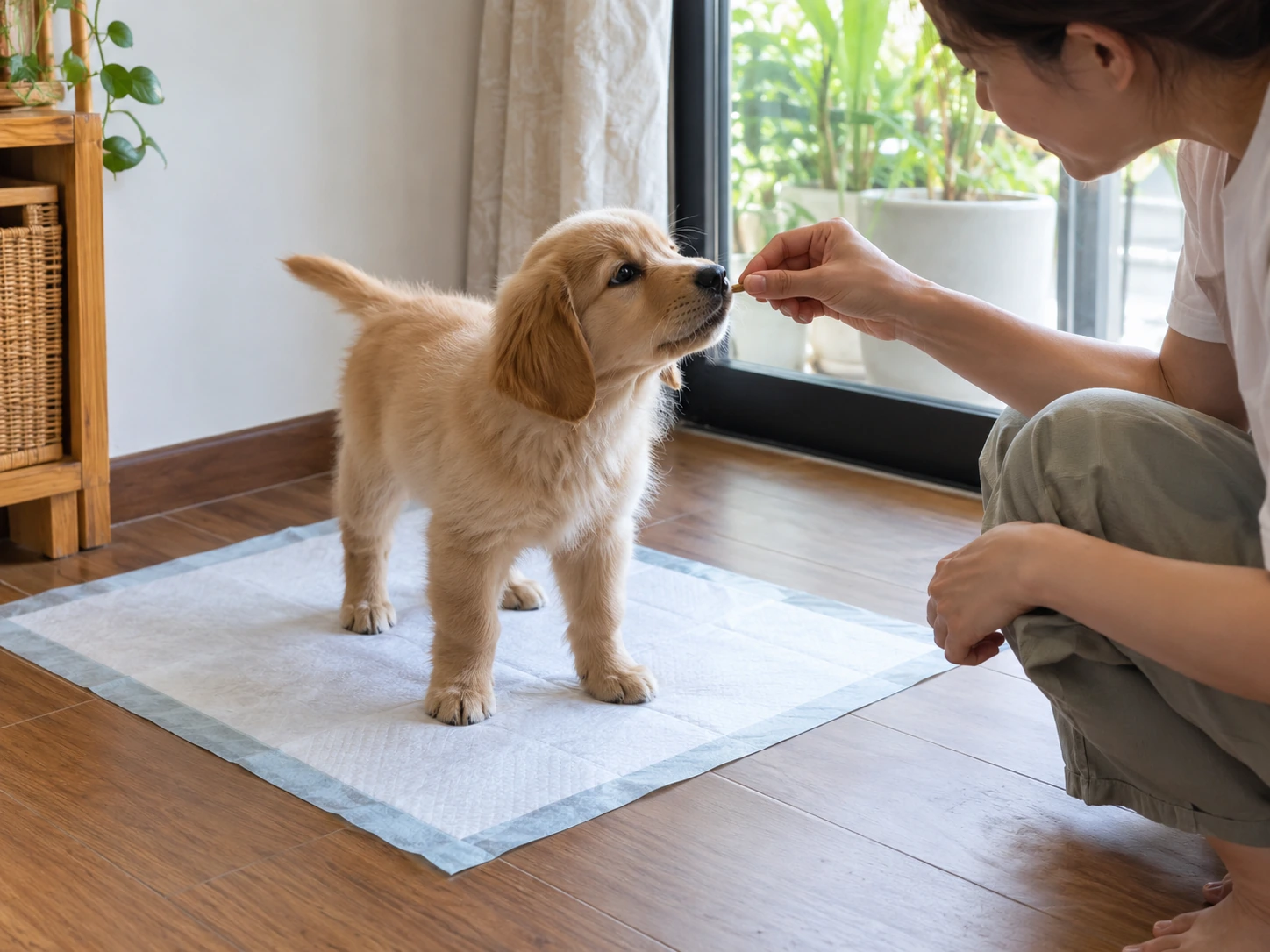
The timing of the reward matters more than the reward itself. Praise or offer a treat the moment your puppy finishes on the pad — not once you’re both back at the sofa.
The reason is that dogs connect a reward with whatever they did in the few seconds beforehand. Leave it too late and your puppy may conclude the reward was for walking back to you.
Use the same short phrase every time — “good job,” for instance — so the puppy pairs that phrase with the correct behaviour sooner.
Step 4: Handling Accidents
These will happen during training. Here’s what to do and what to avoid.
| Do | Don’t |
|---|---|
| Clean thoroughly enough to remove the odour, so the puppy doesn’t return to the same spot | Scold or punish after the event — the puppy can’t make the connection |
| If you catch it mid-act, get its attention gently and move it to the pad | Push its face into the mess, which teaches nothing and damages trust |
| Review whether the miss was down to timing or the distance to the pad | Move the pad immediately on the assumption the spot was wrong |
The key point is that cleaning has to eliminate the odour properly, not simply wipe the floor dry — lingering smell is a signal to the puppy to use that spot again.
Choosing a Pad That Makes Training Easier
The right pad for training is one a puppy steps onto confidently and that doesn’t leave a mess when you pick it up. Three problems come up often: the pad slides underfoot and the puppy loses confidence; liquid isn’t absorbed quickly enough and the paws get wet; and liquid soaks through to the floor as you lift it. These are the features to look for.
| Common problem | What to look for | How it helps |
|---|---|---|
| The pad slides | Adhesive tabs at the corners | Hold the pad to the floor so it doesn’t shift when stepped on |
| Wet paws | Absorbent gel in the middle layer | Takes up liquid quickly so the surface doesn’t stay damp |
| Liquid reaching the floor | Leak-proof film underneath | Stops liquid soaking through to the floor |
Read the label and try it in practice. Pads differ, so read the packaging and start with a small pack to see whether your puppy will step on it and use it consistently, before moving to a larger pack for regular use.
Hi-Life hygienic training pads have a five-layer structure, Super Absorbent Gel in the middle layer, and adhesive tabs at all four corners. They come in packs of 5 for trying out and packs of 50 for regular use.
Frequently Asked Questions
How often should the pad be changed?
Change it once it’s saturated. During training that may be several times a day, since puppies don’t like stepping onto a pad that’s already wet. Wash your hands thoroughly after disposing of a used pad.
If I train on pads, will it be hard to switch to going outside?
It can be done, but it takes time to adjust. The usual method is to move the pad gradually closer to the door, then outside, keeping the same timings and the same rewards throughout. Talk to your veterinarian about the right time to start going outdoors, based on your puppy’s vaccination status.
Will putting pads in several places confuse my puppy?
At the start, several pads within a confined area improve the chances of success. Once your puppy settles on a regular spot, reduce to a single pad so the location is unambiguous.
My puppy chews the pads. What should I do?
This is normal behaviour during the chewing phase. Remove used pads promptly and redirect attention to a toy the puppy is allowed to chew. Keep unused pads out of reach when nobody is watching. If chewing and tearing happen often, supervise closely while your puppy is on the pad, as swallowed material can be dangerous. If you suspect your puppy has swallowed any, or if there’s vomiting, lethargy or a failure to pass waste, see a veterinarian immediately.
In Summary
Toilet training a puppy on pads isn’t difficult, but it does depend on consistency — in where the pad sits, in the timing of each trip, and in rewarding the moment your puppy gets it right. Accidents along the way are entirely normal. What matters is cleaning them up thoroughly rather than punishing.
More About Puppy Pad Training
We hope this guide to puppy pad training helps you care for your pet with confidence. Explore Hi-Life training pads, or keep reading our article How Many Things Do You Need to Look After for One Pet. For more expert information, visit American Kennel Club (AKC).